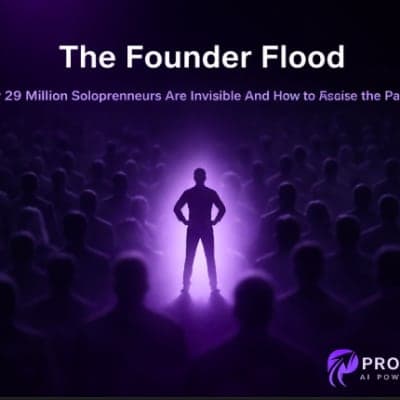
How to Stand Out as a Founder in 2026 When Everyone Is One
Being a founder used to mean something. In 2026, it means almost nothing.
According to LinkedIn and the US Chamber of Commerce 2026 Small Business Report, there has been a 69 percent increase in people adding the word founder to their LinkedIn profiles this year. In the United States alone, there are now 29.8 million solopreneurs generating 1.7 trillion dollars in revenue. Every week, approximately 5 to 7 million new professionals join LinkedIn. The founder title has stopped being a differentiator. It has become the baseline.
If you are a founder or solopreneur wondering why your content is getting no traction, why your DMs are being ignored, why your pipeline is dry despite doing everything right, this blog is for you.
You do not have a content problem. You have an authority problem. And this is how you fix it.
Why Is Everyone Calling Themselves a Founder in 2026?
The short answer: AI lowered the cost of starting a business to almost zero, and the economic pressure of the last three years pushed millions of people into self employment.
According to the 2026 solopreneur statistics, 56 percent of solopreneurs launched their business after the pandemic began, and 57 percent reported that rising costs and inflation forced them to seek additional income sources. Add to that the explosion of no code tools, AI agents, and one hour companies, and you have the perfect conditions for a founder flood.
The barrier to entry is gone. Anyone can spin up a product in a weekend. Anyone can call themselves a founder on Monday morning. The market is not short on founders. The market is short on differentiated founders.
Why Are Founders Invisible on LinkedIn in 2026?
Three compounding reasons. First, organic reach on LinkedIn has dropped by approximately 50 percent year over year. Second, 79 percent of B2B decision makers now actively ignore cold direct messages. Third, the LinkedIn algorithm shifted in 2026 from rewarding velocity to rewarding what is now called the Depth Score, which prioritizes dwell time and meaningful interaction over surface level engagement.
Translation: the old playbook of posting three times a week, sending connection requests, and sliding into DMs no longer works. The platform is rewarding depth, not volume. And depth is built through authority, not activity.
What Does Authority Actually Mean for a Founder?
Authority is not follower count. It is not post frequency. It is not how polished your profile picture is. Authority is the credibility that makes a stranger trust you before the first conversation.
Authority is built on four foundations:
First, a clear category. You are known for one specific thing, not five vague ones. Second, a sharp point of view. You have an opinion the market can argue with, not generic observations. Third, a visible body of work. There is evidence of your thinking across multiple platforms over time. Fourth, consistent positioning. Your message is the same whether someone finds you on LinkedIn, YouTube, or your website.
Most founders have none of these four. That is why they are invisible.
How Do You Build Founder Authority in 2026?
Start with category ownership. Pick one narrow space you want to be known for. Not marketing. Not AI. Not growth. Something specific like AI powered lead generation systems for service businesses, or authority building for B2B consultants.
Then build a sharp point of view on that category. What do you believe that your competitors do not? What is the one thing you think the market is getting wrong? This is your thesis. Your content is the proof.
Then distribute that thesis consistently across multiple platforms. One core insight becomes a LinkedIn post, a video, a blog, a newsletter section, and a podcast clip. That is the content multiplication engine used by the top 1 percent of founders in 2026.
Finally, prove it. Case studies, client results, data, frameworks. Authority is not claimed. It is demonstrated.
Why Do Most Founders Fail at Authority Building?
Because they confuse authority with visibility. They think if they just post more, they will be seen more. But 1.3 million feed updates are viewed on LinkedIn every single minute. More content does not cut through. Sharper content does.
They also confuse authority with originality. They try to invent new frameworks every week instead of building a library of assets that prove one clear thesis over and over.
And finally, they try to do it manually. Four hours a day writing content, engaging with comments, scheduling posts. It is unsustainable for any founder running a company. Which is why AI powered authority systems are no longer optional in 2026.
What Is the Fastest Way to Build Authority as a Founder?
The fastest way is a system. Not a burst of motivation. Not a content calendar. A system that handles positioning, production, and distribution simultaneously.
This is exactly what the PropelusAI Authority Launchpad was built for. It is the authority building engine inside Propelus OS. It takes a founder from invisible to established in 90 days by combining category positioning, AI powered content production, and multi platform distribution into one unified system.
You do not need to post more. You need to post smarter, with positioning that makes you impossible to confuse with the 29 million other solopreneurs in your feed.
Which LinkedIn Strategy Works for Founders in 2026?
The strategy that works in 2026 is what LinkedIn strategists call the Super Commenter plus Depth Score model. Instead of only posting your own content, you strategically engage with posts from established voices in your category, adding insightful comments that demonstrate your point of view in front of their audience.
This generates profile visits, inbound connection requests, and conversations without the cold outreach that 79 percent of decision makers now ignore.
Combined with a sharp personal brand positioning and consistent long form content, this strategy is the foundation of modern founder led marketing.
How Long Does It Take to Build Authority as a Founder?
Most founders can achieve visible authority within 60 to 90 days if they follow a system. The mistake is trying to build authority without a framework, which can take two or three years.
The compounding effect of clear positioning plus consistent content plus strategic distribution is what creates the speed. Without all three, authority building becomes a slow, frustrating grind.
Is Founder Led Marketing Still Worth It in 2026?
More than ever. The same 2026 LinkedIn data shows that 40 percent of users interact with business pages every week, average engagement rates on LinkedIn are 3.85 percent (higher than Facebook and Instagram for B2B content), and personal brand content consistently outperforms company page content for reach and trust.
Founder led marketing is not dying. Generic founder led marketing is dying. Strategic, system powered founder led marketing is the single highest leverage play a founder can make in 2026.
Frequently Asked Questions
How many founders are on LinkedIn in 2026?
According to LinkedIn and the 2026 US Chamber of Commerce Small Business Report, there has been a 69 percent increase in people adding founder to their LinkedIn profiles this year. LinkedIn now has over 1.3 billion total members worldwide.
Why is my LinkedIn organic reach dropping in 2026?
LinkedIn organic reach has dropped approximately 50 percent year over year due to the platform shifting to the Depth Score algorithm, which prioritizes dwell time and conversational depth over surface level engagement.
What is the best way for a solopreneur to stand out in 2026?
The best way to stand out is to own a narrow category, develop a sharp point of view, and distribute that thesis consistently across multiple platforms using an AI powered content system.
How do I build authority without posting every day?
You build authority through positioning, not frequency. One clear thesis, multiplied across formats and platforms, outperforms daily generic posts every time.
What is the Authority Launchpad from PropelusAI?
The Authority Launchpad is the authority building engine inside Propelus OS. It combines category positioning, AI powered content production, and multi platform distribution to take a founder from invisible to established in 90 days.
Does cold outreach still work for founders in 2026?
No. 79 percent of B2B decision makers now actively ignore cold direct messages. Inbound authority based marketing is the new default for founder led growth.
How much content should a founder post in 2026?
Quality and positioning matter more than quantity. One sharp, well positioned post per week outperforms five generic posts per week under the 2026 Depth Score algorithm.
What makes a founder authority different from influencer authority?
Founder authority is built on business credibility, client results, and strategic expertise. Influencer authority is built on personality and entertainment. B2B buyers trust founder authority to make purchasing decisions.
Can AI help me build authority as a founder?
Yes. AI powered authority systems like Propelus OS can automate content production, distribution, and engagement at scale, giving founders their time back while accelerating visibility and credibility.
How do I know if my authority building is working?
Key signals include inbound profile visits, unsolicited DMs from qualified prospects, increased call bookings without outreach, and being mentioned or tagged in industry conversations.
The Bottom Line
The founder title is no longer a signal. It is noise. 29.8 million solopreneurs are fighting for the same feed, the same audience, the same pool of customers. The ones winning are not working harder. They are positioning sharper.
In 2026, authority is the only moat. Build it with a system, or get drowned by the flood.