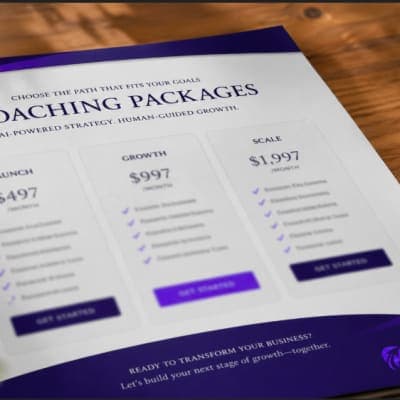
A coach launches a 12-week program at 1500 USD. Sells 3 spots. Feels good.
Three months later, the coach raises the price to 2500 USD. Sells 3 spots. Feels better.
Six months later, the coach raises to 5000 USD. Sells 3 spots. Realizes something strange. The number of spots is constant regardless of price.
This is the coaching offer trap. Most coaches think they have a pricing problem when they actually have an offer architecture problem. Pricing changes the revenue. Offer architecture changes the business. Here is the difference.
What is the coaching offer trap and why are most coaches stuck in it
The coaching offer trap looks like this. The coach has one core offer. A 12-week program, or a 6-month container, or a quarterly mastermind. The coach raises and lowers the price of this one offer based on demand signals.
The trap is that the coach has built a price ladder, not an offer architecture. They are competing on themselves at different price points instead of building a system where different prospects enter at different levels.
The result. Every prospect either fits the one offer or does not. There is no middle ground. There is no entry path. There is no upsell path. Every conversation is a binary yes or no on a single offer at a single price.
The coaches who escape this trap in 2026 do not raise prices. They restructure their offer entirely.
What does a 2026 coaching offer architecture actually look like
A working coaching offer architecture has 3 levels. Each level is designed for a different stage of prospect readiness.
Level 1. Entry offer. 99 USD to 500 USD.
The entry offer exists to convert browsers into buyers. The cost is low enough that prospects can say yes without a decision-making process. The value is high enough that the prospect feels they got more than they paid for.
Examples that work. A 90-minute strategy session with a written followup. A 7-day intensive on a specific problem. A premium template pack with 30 minutes of customization support. A small-group workshop on a tight topic.
The entry offer is not designed to be your main revenue stream. It is designed to start a relationship with a prospect at low risk to them and minimal time investment from you.
Level 2. Core offer. 1500 USD to 5000 USD.
The core offer is your main coaching program. This is what most coaches today have as their only offer. In a working architecture, the core offer is what entry-level prospects upgrade into after they have experienced your style.
The core offer should be 8 to 16 weeks long, deliver a specific transformation, and require enough commitment from the client that they treat it seriously.
Coaches who hit 25K to 50K MRR typically generate 60 to 70 percent of their revenue from the core offer.
Level 3. Premium offer. 10,000 USD to 50,000 USD.
The premium offer exists for clients who are ready to pay for outcomes, not for time. This is high-touch work, often delivered as a 6 to 12 month engagement with a specific business or life outcome guaranteed.
Most coaches resist building a premium offer because they do not feel they can charge that much. The reality is that the premium offer is what positions the entire architecture. Without a premium tier, the core offer feels expensive. With a premium tier, the core offer feels reasonable. The premium tier creates anchoring that makes the rest of your pricing make sense.
Why does pricing alone never solve a coach's revenue problem
Most coaches think they need to raise prices. The math seems to support it. 3 clients at 5000 USD is more revenue than 3 clients at 2500 USD.
The trap is that the same number of prospects do not convert at every price. As price goes up, conversion rate goes down. The revenue curve looks like a hill, not a slope. There is an optimal price point for any single offer, and most coaches are already close to it.
The way to break the revenue ceiling is not to raise prices. It is to add levels. A coach with one 2500 USD offer might convert 20 percent of qualified prospects. The same coach with a 99 USD entry offer, a 2500 USD core offer, and a 15,000 USD premium offer might convert 80 percent of qualified prospects across the three tiers combined.
The 80 percent versus 20 percent is the actual leverage. Pricing changes do not move that number. Architecture changes do.
How are AI agents helping coaches build and run multi-tier offer architectures in 2026
The reason most coaches do not build a 3-tier architecture is not that they do not understand it. It is that they cannot manage 3 different prospect journeys simultaneously.
A 3-tier architecture requires.
Different content for different awareness levels. Different lead nurturing sequences for different intents. Different sales conversations for different price points. Different delivery systems for different commitment levels. Different upgrade paths from each tier to the next.
For a solopreneur coach, this is too much manual work. The coach ends up either building a 3-tier system that they cannot operate, or staying with a 1-tier system that limits their revenue.
In 2026, AI agents have changed this. A single platform can run all 5 of these systems simultaneously, tagging prospects by tier intent, routing content by readiness level, and handling the operational complexity that used to require a team.
This is what enables solopreneur coaches in 2026 to operate the same kind of multi-tier offer architecture that used to require a team of 3 to 5 people.
What does a coach making 50K MRR with a 3-tier architecture actually deliver
A working 3-tier architecture at 50K MRR usually breaks down like this.
Entry offer. 99 USD strategy sessions. 30 sessions per month. 3000 USD MRR. Used as a top of funnel acquisition mechanism.
Core offer. 2500 USD per month for a 6-month program. 12 active clients. 30,000 USD MRR. The bread and butter.
Premium offer. 15,000 USD per quarter for high-touch executive coaching. 1 active client per month. 17,000 USD MRR. The anchor offer that positions the rest.
Total. 50,000 USD MRR. Same coach, same core skill, but a structure that captures prospects at every level of readiness instead of forcing every prospect through the same single offer.
Frequently asked questions about coaching offer pricing in 2026
How much should a solopreneur coach charge for a coaching package in 2026
It depends on outcome and audience. For business and executive coaching, 2000 USD to 5000 USD per month is the standard core offer range. For life and mindset coaching, 1000 USD to 3000 USD per month. For specialty or premium coaching, 5000 USD per month and up.
When should a coach raise their coaching prices
When the current price is converting at over 50 percent of qualified prospects. If conversion is over 50 percent, the price is too low for the value being delivered. Below 30 percent conversion usually signals the price or offer needs reworking.
Should coaches charge per session or per package
Always per package. Per-session pricing creates client uncertainty and makes the coach feel like a service vendor instead of a transformation provider. Package pricing aligns the financial commitment with the outcome being delivered.
What is the lowest price a coach should charge in 2026
For a coaching package designed to drive a specific outcome, 500 USD is the floor. Below that, prospects do not commit seriously and outcomes suffer. The exception is entry offers (90-minute sessions, intensives, workshops) which can sit between 99 USD and 499 USD.
How do coaches build a premium tier offer
Start by identifying what outcome a high-budget client would pay 10,000 USD or more for. The outcome is usually quantifiable (revenue increase, role change, weight loss target, business exit). Build a 6 to 12 month structured program around that outcome. Limit availability to create scarcity.
How do coaches transition existing clients to higher prices
Existing clients keep their current pricing. New clients enter at the new pricing. This is the only ethical and effective way to handle pricing changes. Grandfathering existing clients builds trust and allows the new pricing to take hold without churn.
Will lowering my coaching prices increase the number of clients
Sometimes, but at a cost. Lower prices attract lower-commitment clients who get worse outcomes and refer less. Most coaches who lower prices regret it within 6 months because the energy drain from lower-quality clients exceeds the revenue gain.
What is the most common pricing mistake new coaches make in 2026
Pricing the offer based on what they think prospects will pay instead of what the outcome is worth. Outcome-based pricing produces 3 to 10x the revenue of effort-based pricing. New coaches need permission to price what they deliver, not what they cost to produce.
Should coaches publish their prices on their website
Mid-tier offers (1500 USD to 5000 USD) yes. Premium offers (10,000 USD plus) no. Premium offers should require a conversation before pricing is shared. The conversation itself filters out unfit prospects and qualifies fit ones.
How long does it take to build a working 3-tier coaching offer architecture
3 to 6 months from start to fully operational, assuming you have an existing core offer working. Most of the time goes into building the infrastructure (lead capture, sales sequences, delivery templates) for each tier.
Conclusion
Pricing changes revenue. Offer architecture changes the business.
Coaches who escape the 5K MRR plateau, the 25K MRR plateau, the 50K MRR plateau, do so by restructuring their offer architecture, not by raising prices on a single offer.
The 3-tier architecture in 2026. Entry offer (99 USD to 500 USD). Core offer (1500 USD to 5000 USD). Premium offer (10,000 USD to 50,000 USD).
Building and running this kind of multi-tier system used to require a team. In 2026, AI agents have made it operationally possible for solopreneur coaches.
PropelusAI is launching Soul on September 8, 2026. It is built specifically for solopreneur coaches who want to operate multi-tier offer architectures without the operational overhead. 5 autonomous agents handle the content, lead routing, sales nurturing, and delivery automation that lets coaches scale without hiring.
The first 100 founding members lock in lifetime pricing of 49 USD per month, half of the launch price.